


I'll start with an opinion, since that's where this text began, and there's no point in pretending to be impartial. August 2025, Paredes de Coura. Lambrini Girls on stage, on the 15th. Bodies close together, heat, energy concentrated in a relatively small but super-intense space.
It was more than a concert. There was something even harder to define, a kind of collective consciousness. As if the band and the audience were fully aware of their purpose there. It wasn't, in the classic sense of music criticism, a historic concert. There were no great solos, no memorable moments, and they didn't become legends. However, there was something else that, to me, seems more significant today: a distinct idea of modernity. That music, that attitude, that presence made sense in 2025. And they are even more understandable now. Not only the sound, direct, sarcastic, unadorned, but the way they occupied the space impressed me. In the mosh pit, there were women in the middle, without hesitation, without theatricality, without that old feeling that they needed to prove something.
They occupied that space not to oppose or be exceptional, but because they were residents. And that changes everything.
That's what this text is based on, and it doesn't end there. It's because this is not an isolated case, nor an aesthetic coincidence. There is a movement in heavy rock, punk, hardcore, and contemporary metal. A widespread flow, not so marked by a proclamation, but with an apparent orientation.
A regressive world and music as a response
We live in a highly conflicted culture. On the one hand, there is talk of freedom, diversity, inclusion, and progress. On the other hand, there is aggressive neoconservatism, which often hides behind rational, meritocratic, or even psychological language.
This conservatism finds very fertile ground among young people due to media personalities such as Andrew Tate, Jordan Peterson, and an ecosystem of red pills, resentful masculinity podcasts, emotional success coaches, and forums where personal resentment is transformed into political identification. Incel culture is no longer a marginal subculture, but a social symptom. It is a discourse in which the blame for the loss of male status is attributed to women, feminism, and social change. An argument that denies empathy, complexity, and self-criticism and desires straightforward explanations about the world that should be different.
This discussion is not limited to the internet. It permeates our daily lives, our relationships, pop culture, and discourse on gender, sexuality, and power. And that is where the current generation of heavy bands led by women gains symbolic power that goes beyond music in many ways. We are not talking about bands that literally write songs about feminism. We are discussing a presence that is political. Of bodies that occupy space, of voices that do not ask for permission, of sounds that do not adapt to please.
The body as a message
Heavy rock has always been closely linked to the body. The loud volume, the physical intensity of the music, the mosh pit, the touching, the exhaustion. For a long time, this body was implicitly masculine. Strong, resilient, dominant. The presence of women was accepted, if it did not challenge this order too much.
What is happening today is a discontinuity of this logic. Not a noisy or violent rupture, but a convenient change. Women who make up the stage and the audience without changing their behavior, without diluting their body language, without enjoying aggression as something permissible.
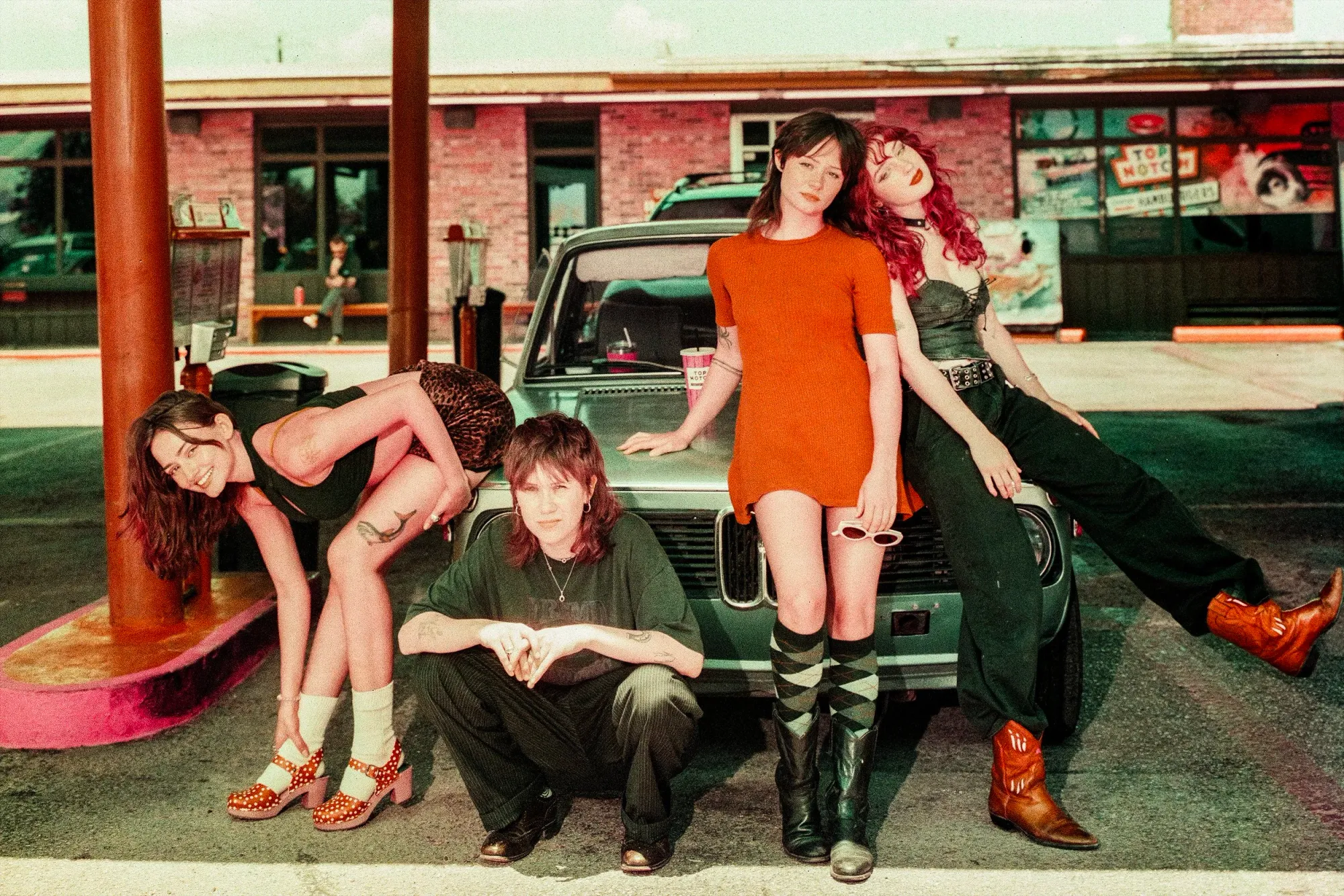
An example of this is Lambrini Girls. They were born in Brighton and play simple, sarcastic, and politically conscious punk, but without falling into propaganda. The lyrics talk about sexual violence, misogyny, social hypocrisy, structural inequality. However, it is not what they say that matters most, it is how they live. There is no pedagogy there. There is confrontation. There is dark humor. Their refusal to be tamed is evident.
This denial permeates most of the bands that are reshaping modern heavy music.








Women at the forefront, without concessions
Bands like Scowl, Pest Control, Die Spitz, Faetooth, Messa, Amyl and the Sniffers and Lambrini Girls represent completely different soundscapes, although they are united by one important characteristic: they do not build their identity based on the masculine.
Scowl, a member of the Californian hardcore scene, with Kat Moss as its star, mixes the traditional aggression of hardcore with a stage performance that cannot be explained or justified. There is no effort to soften the impact and fit the archetype of a good vocalist. There is open conflict, physicality, and a voice that demands recognition without asking permission.
British band Pest Control mixes thrash, hardcore, and punk with a raw, almost old-school intensity. Female leadership is not a marketing idea, but a reality. Die Spitz, from Texas, is direct, young, and politically incisive anger, and Faetooth is atmospheric, slow, heavy, and doom metal, with emotion and strength coexisting in a non-hierarchical relationship.
Messa, on the other hand, is more on a ritualistic and spiritual level. It's dense metal with a hypnotic melody, and the female voice probably doesn't fit the usual archetypes. There are no constant screams, but there is total control over the sound space. A restrictive force rather than an explosive force.
And then there's Amyl and the Sniffers, perhaps the most visible case of this wave: raw, direct punk, heir to the Australian tradition, led by Amy Taylor, whose stage presence combines aggression, humor, untamed sexuality, and a clear rejection of respectability. Amyl doesn't soften, doesn't apologize, doesn't represent an acceptable femininity — she occupies the stage with the same urgency and insolence that for decades was reserved for men. In all these cases, the common thread is not the musical genre, but the attitude: autonomy, total presence, and a clear refusal to be tamed.
In each case, the disregard for expectations is evident. These bands do not exist to represent women in rock. They are there because they want to be there. And that is perhaps the most radical action of all.
Noise as reoccupation: Hardcore
The hardcore scene also deserves further analysis, as I am a big fan of the genre. It has been one of the most strictly male-dominated areas of heavy music in recent decades, a space characterized by specific physical codes, general performative aggression, and a culture of normalized exclusion.
What is happening today is not so much an aesthetic cleansing or dilution of the genre. It is a reoccupation. Groups such as Buggin, Spaced, and the now-defunct GEL show that it is possible to preserve everything that makes hardcore relevant, such as urgency, intensity, physical confrontation, and collective catharsis, without recreating the old forms of toxic masculinity.
From Chicago, Buggin revives old-school hardcore with an almost anarchic vitality, albeit endowed with a sense of humor and unity. Women here do not make the sound softer. Quite the contrary, they free it from a rigidity of identities that has restricted the genre over the years. Spaced adds an almost carnival-like element to the commotion. Hardcore, in this case, is both extreme and welcoming. Moshing ceases to be an act of physical domination and becomes a shared space of human bodies that have no implicit hierarchy. And GEL, which no longer exists, helped pave the way. Over the years it operated, it demonstrated that it was not necessary to change hardcore to make it more inclusive. The convention was enough to fill it without consulting anyone. The band ultimately came to an end following the alleged conduct of one male member, whose behaviour was widely perceived as misogynistic, disrespectful toward others, and marked by an extreme form of narcissism.
This is a change within the interior of the building - the culture, the people, the way people traverse space. Hardcore has become loud, aggressive, uncomfortable, and can no longer be associated with a body type or a concept of power.
It's not new, but it's never been like this
It is important to note that heavy rockers never disappeared. In the 1970s, The Runaways led the way in a super-masculine universe. Persistence and refusal were the foundations of Joan Jett's career. It took decades of deconstruction of gender, sexuality, and authorship by PJ Harvey. A controversial and contradictory woman, Courtney Love showed the limits of male tolerance in rock. The Breeders showed that there was room for other stories and other sensibilities. The riot grrrl movement, represented by Kathleen Hanna's Bikini Kill, was a modern movement explicitly linked to punk, feminism, and DIY in the 1990s, forming support networks, its own language, and safe spaces. But riot grrrl was quite regional, with a very clear aesthetic and political identity.
What we see now is different. There is no manifesto. There is no closed aesthetic. There is no single center. It's Hardcore, Doom, Metal, Noise. What unites these bands is not a genre; it's an attitude of independence, presence, and not being disciplined.
Pop, sexuality, and false controversy
One point must be made clear. This is not an attack on female pop divas or pop music created by women. Sexuality has never been a problem. The contrast lies in narrative control. Female sexual freedom is generally subject to moral decay in an era of neoconservatism. However, the difference between forced hypersexualization and supposedly voluntary sexuality is very profound.
Yet, in the specific scenario of the response to incel and red-pill culture, mainstream pop tends to be easily absorbed by the market, which neutralizes its disruptive aspects to a certain extent. Heavy rock, on the other hand, is still unsellable, uncomfortable, and difficult to control. It is not easy to turn it into a fantasy. It is difficult to consider it inspiring. And that is precisely what makes it a rich area of cultural opposition.
The conclusion: it is not a trend, but a symptom
It is not a trend or a wave generated by algorithms. It is a symptom. The world of tension it directly reflects is a place where retrograde discourses are on the rise and a place where many women feel the need to physically occupy their own space, which has been historically infringed upon. Space is not something these bands are demanding. They are occupying it. They are not explaining anything. They are not negotiating their existence. They are living loud, heavy, and unapologetically.And that is uncomfortable.
It is strange because it goes against expectations. The reason it is uneasy is that it breaks the narratives of female fragility. It is uncomfortable because it indicates that the future of heavy music is not nostalgia or regression, but change. That is probably what should be remembered most.
With all the noise, commotion, and distortion, these bands are doing something incredibly simple: they are stamping their feet in a world that wants to push them away. And today, that is already a sufficiently radical political gesture!